Shopping Guide
Where to Actually Buy Stationery in Tokyo: Ito-ya, Loft, Hands, and Where Locals Go Instead
Ask a tourist where to buy stationery in Tokyo and almost every one of them says Ito-ya. Ask someone who actually works in a Tokyo office, and the honest answer is usually a lot less glamorous — whatever’s on the shelf at the drugstore by the station, or the convenience store register display if it’s urgent. Both answers are correct. They’re just for different trips.
The short version: if you want the full experience — twelve floors of pens, paper, and gift-wrapping under one roof — go to Ito-ya’s Ginza flagship. If you want one solid floor of everyday stationery without the tourist crowd, Loft (the basement floor, specifically) covers it. Hands — the store most people still call by its old name, Tokyu Hands — is the broadest of the bunch, selling stationery alongside hardware and home goods. And if what you actually need is art supplies rather than office supplies, Sekaido in Shinjuku is the one worth the detour. For the stuff nobody plans a trip around — a pen, a notepad, correction tape — the nearest drugstore or 100-yen shop will have it in under two minutes.
Why Tokyo has this many stationery stores in the first place
Part of it is scale: Tokyo is enormous, so “the stationery store” ends up meaning five or six different chains depending on which neighborhood you’re standing in. But a bigger part of it is cultural. Japanese elementary schools hand parents a supply list every April that specifies pencil hardness and sometimes even which brand of glue stick is acceptable. Offices run on handwritten memo pads long after most Western offices switched to Slack. And December brings the annual ritual of hand-addressed New Year’s postcards (nengajo), which means stationery sections quietly double in size every autumn. None of that is a hard sell. It’s just infrastructure.
That’s why the stores split so cleanly by purpose instead of competing head-on. Nobody in Tokyo is debating Ito-ya versus the pharmacy.
They’re different errands.
Ito-ya, Ginza — the one for browsing and gifts
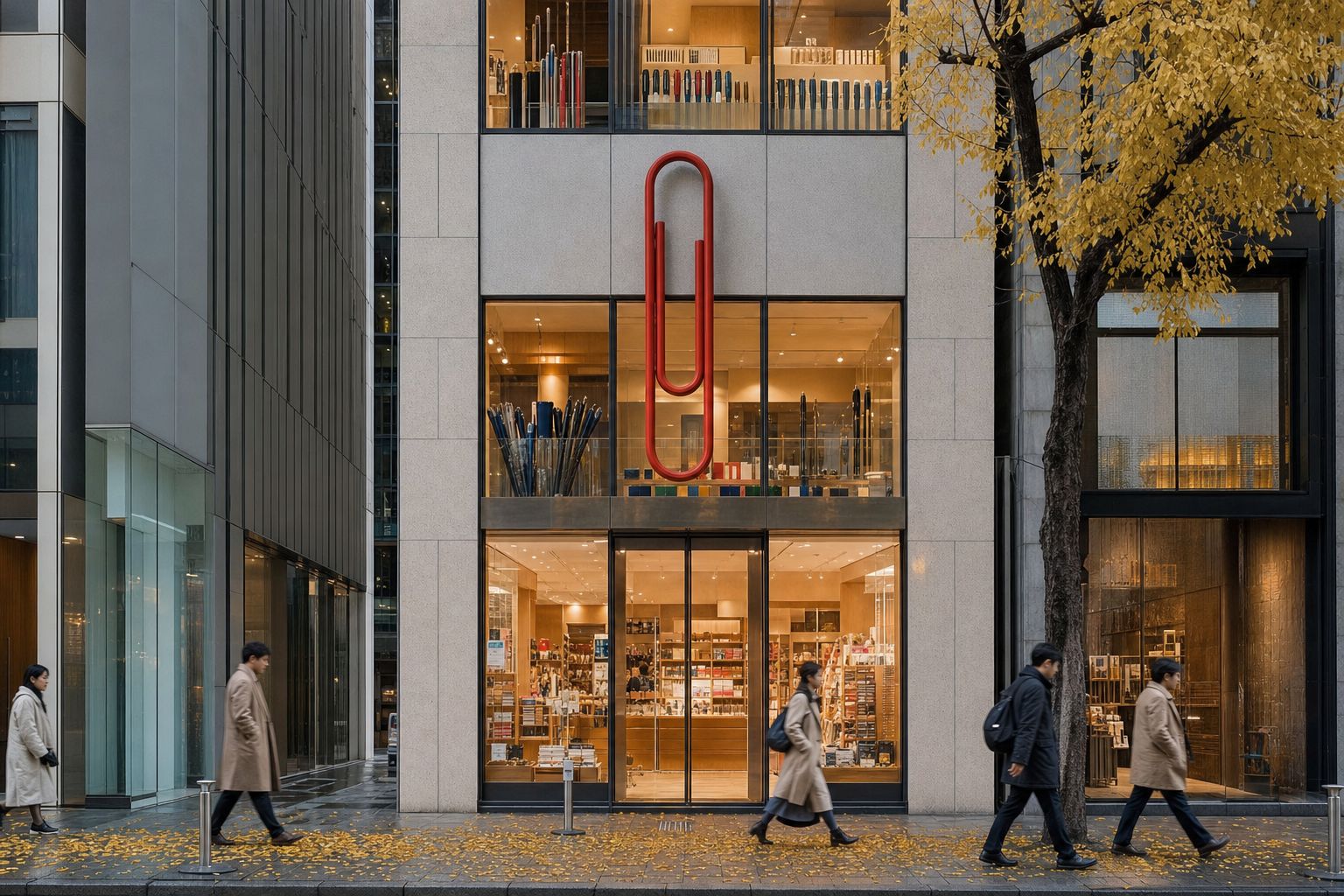
Ito-ya’s main Ginza location is really two buildings working together: G.Itoya, the main building, and K.Itoya, a smaller annex behind it. G.Itoya runs to roughly twelve floors and is the one you’ll recognize from photos by the giant red paper clip mounted over the entrance; K.Itoya’s entrance has a matching oversized fountain pen. Between the two buildings you get pens, fine paper, notebooks, art supplies, custom stamp-making, and a made-to-order notebook service — plus, on the upper floors, event space and a small rooftop garden. The address is 2-7-15 Ginza, a short walk from Ginza Station, and it’s worth going on a weekday if you can, because the ground floors get genuinely crowded on weekends.
This is the store for gifts, not restocking. Nobody is running in for a ¥150 gel pen at Ito-ya. You go when you want to see the full range of what Japanese paper and pen-making can do, or when you’re buying something for someone back home.
Loft and Hands — the everyday options
Loft traces back to 1987, when it opened as an annex to the Seibu department store in Shibuya, built around the idea of curating well-designed everyday goods rather than just stocking function. The flagship Shibuya store runs about seven floors (counting the basement), and the basement floor specifically is given over almost entirely to stationery — pens, notebooks, planners, pen cases, calendars, book covers, the whole everyday lineup. It’s the closest thing to a one-floor stationery department store that still feels edited rather than overwhelming.
Hands is the other big name, though almost nobody calls it that yet. Tokyu Hands became just Hands in late 2022, after the retailer Cainz acquired the chain that spring, and the Tokyo design studio nendo built the new identity around a single-brushstroke version of the kanji for “hand” (手). The name change rolled out gradually, with the old “Tokyu” branding set to be phased out by March 2024, which is why you’ll still hear longtime shoppers default to the old name out of habit. Hands carries stationery too, but it sits inside a much bigger store that also sells hardware, travel goods, and home organization — think of it as the department store version of a stationery run, useful if you need a notebook and also, say, a travel adapter.
Sekaido, Shinjuku — for art supplies, not office supplies
Sekaido’s Shinjuku location, about a six-minute walk from Shinjuku Station, is a five-or-six-floor specialty art store rather than a general stationery shop. The ground floor has everyday pens and notebooks, but the floors above move into paint, brushes, drawing paper, calligraphy tools, and framing — the kind of inventory you’d actually need an art-school trip for. If someone recommends Sekaido for a basic notebook, they’re sending you to the wrong store on a technicality; it’s excellent, just excellent at something more specific than “stationery.”
The one-sentence honest category: everything else
Drugstores, supermarkets, convenience stores, and 100-yen shops (Daiso being the obvious one) all carry a working slice of the same stationery you’d find at the stores above — correction tape, basic notebooks, ballpoint pens, erasers. None of it is curated. All of it works.
A personal note here, since I should be honest about it: I don’t actually use much stationery day to day anymore. What’s on my desk is a ballpoint pen and plain paper for taking notes, bought wherever happened to be closest when I ran out — which, more often than not, means I never set foot in Ito-ya or Loft for my own stuff. The flagship stores are genuinely worth visiting if you’re curious or buying a gift. For keeping a pen that writes, they’re overkill.
If you want a specific recommendation instead of a browsing trip, I’d point you toward what’s already proven itself rather than the newest display at the entrance — the pens that show up in every Tokyo office are a safer bet than whatever’s trending on the seasonal table.
What’s actually worth the trip, and what isn’t
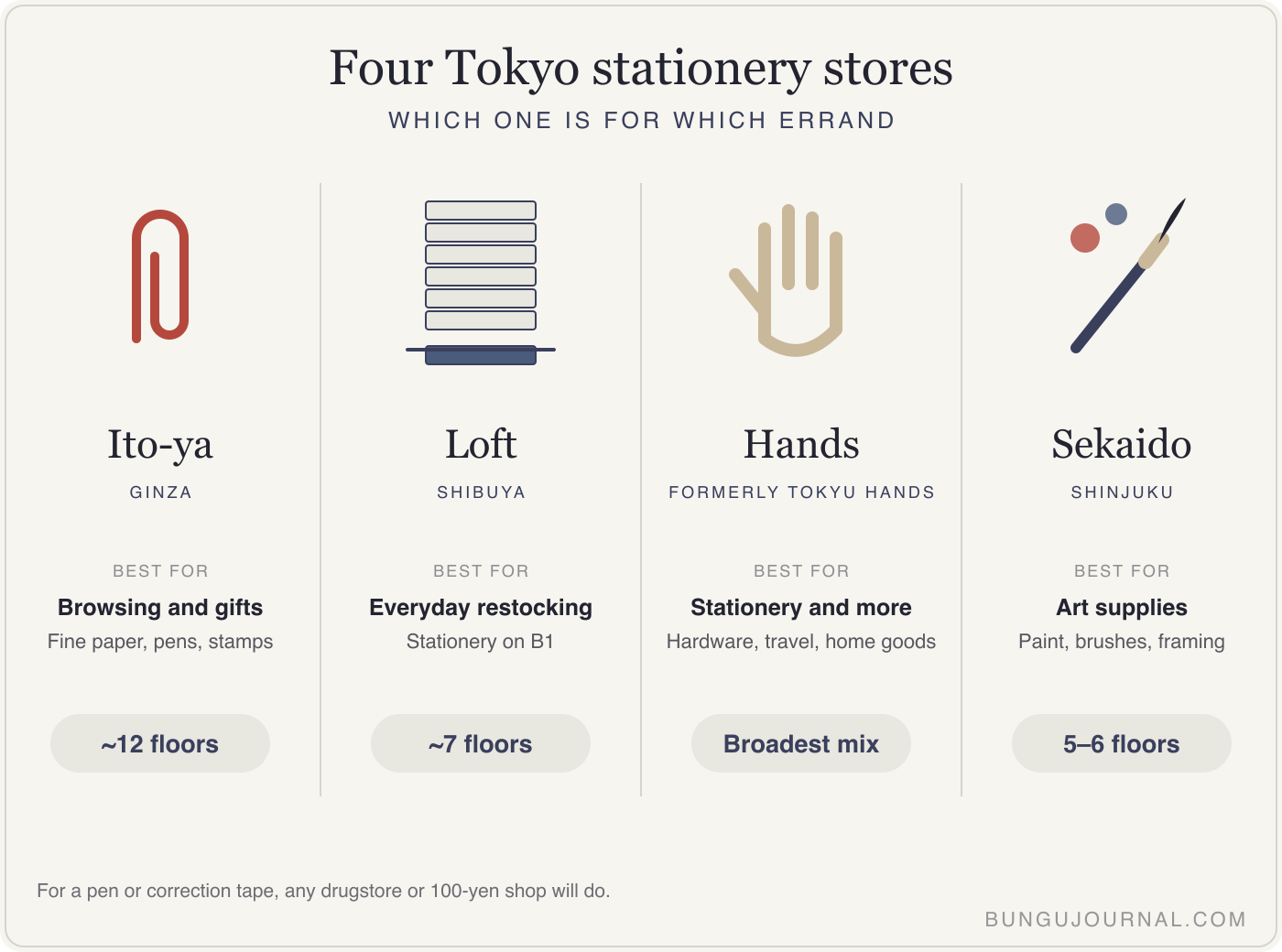
If you’re visiting Tokyo for a few days and stationery is on the list, Ito-ya Ginza earns the detour — it’s a genuine browsing destination in its own right. Loft’s basement floor is the efficient alternative if you have less time and want to see a tight, well-edited selection in twenty minutes instead of two hours. I’d skip paying tourist-shop prices for character-printed “Japan” souvenir notebooks at the airport or hotel gift shop; the same paper quality, without the printed Mt. Fuji, is sitting in any of the stores above for less.
One small bungu-ya (文具屋 — the Japanese term for a stationery shop, used for everything from a corner mom-and-pop to a department floor) detail that surprises first-time visitors: staff at these stores will often let you test-write a pen on a scrap pad at the counter before you buy it, which sounds obvious but isn’t standard practice everywhere. Take them up on it, especially for fountain pens, where nib feel varies store display to store display depending on how many other people have already tried it that day.
If you can’t make the trip
Not everyone reading this is going to be in Tokyo this year, and that’s fine. The actual products are the point; the building they’re sold in isn’t. Stationery Pal ships a solid range of the same Kokuyo and Japanese pen brands internationally, and the code 75 knocks 16% off an order if you want to try a few things before committing to a Tokyo shopping list. It’s not a replacement for wandering Ito-ya in person, but it covers the actual stationery, which — Ito-ya’s twelve floors aside — was always the point of the trip.
For a narrower starting point than “everything,” the Japanese notebooks guide and the Hobonichi Techo breakdown both cover single categories in more depth than a store tour ever could, and the pencil case guide is a good one if you’re shopping for a kid heading into the Japanese school system, where the supply list is a lot more specific than it looks.
The Desk Reset (Free)
A 10-minute checklist to set up a calm, analog-friendly desk — the Japanese office worker way. Printable, one page.
Get the checklist →