Pencil Cases
Japanese Pencil Cases, Explained: The Box We All Grew Up With vs. the Pouch That Stands Up on Its Own
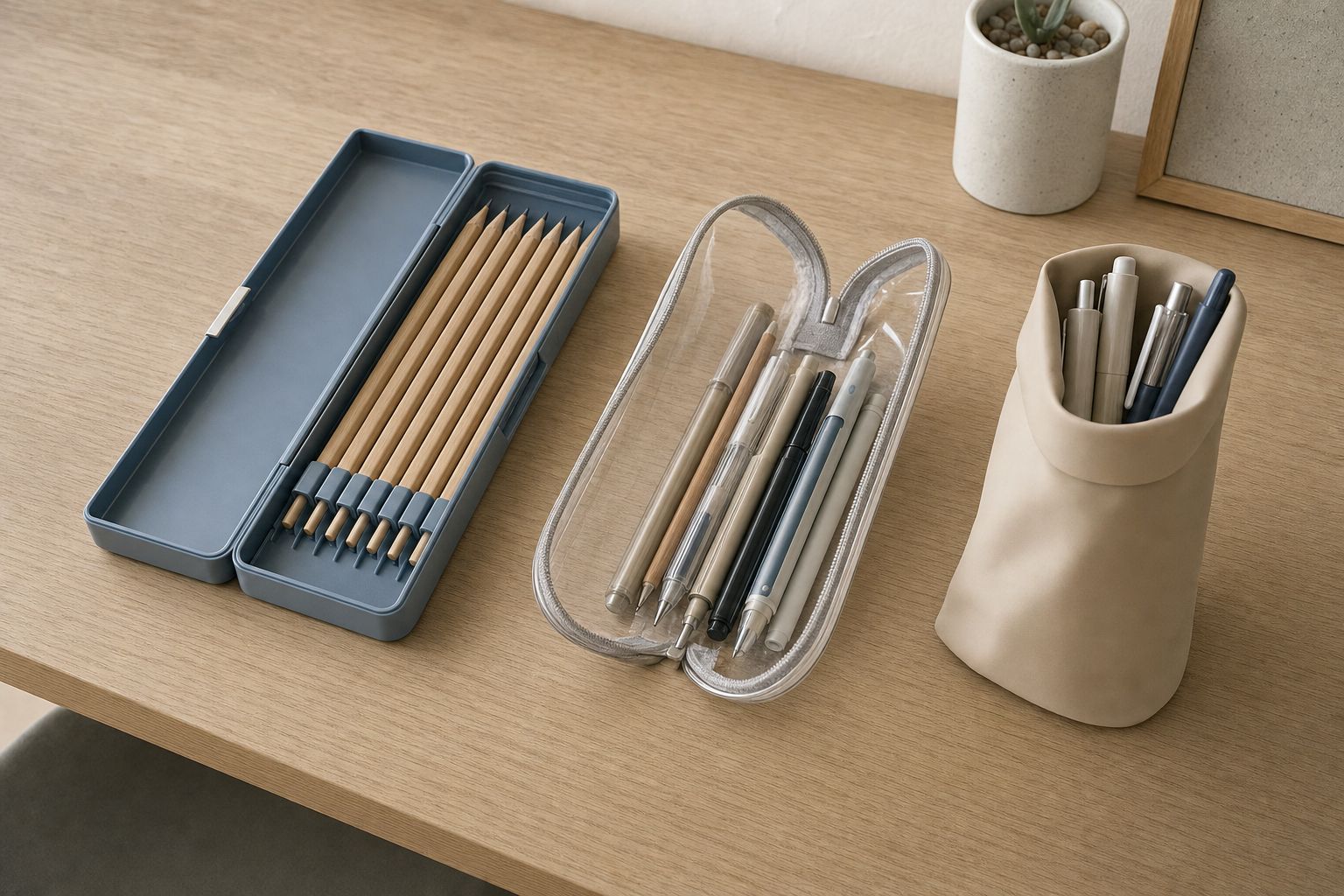
Walk into a stationery aisle in Japan and the pencil case section isn’t a shelf, it’s practically its own department. Hinged boxes, double-opening boxes, cases that stand upright like a cup, cases that unzip and fold open into a tray — Japan treats the humble pencil case as a real design category, not an afterthought you grab on the way to the register.
The short answer: the Lihit Lab Smart Fit PuniLabo (about ¥1,710) is the one to buy if you want a soft case that holds its shape and stands open on your desk instead of lying flat like dead weight. If you’d rather see everything at a glance in something slim enough to disappear into a bag, get Kokuyo’s C2 in its clear version (about ¥1,078) instead. And if you want the hard-sided, double-opening box that’s still standard issue at Japanese elementary schools, that’s a different animal entirely — what I remember keeping in mine was battle pencils, not serious stationery, which tells you most of what you need to know about what Japanese kids used these things for.
A pencil case rule for every school
Japanese elementary schools famously hand parents a supply list in April specifying almost everything down to the pencil’s hardness grade. Pencil cases get the same treatment, and the rules vary wildly by school. Some schools don’t care at all. Others ban character-printed designs outright, or require a plain, no-pattern box-type case specifically — it depends entirely on which school your kid lands in, which is a strange kind of lottery when you think about it.
That variation is part of why the category is so deep. A product line has to cover the school that wants a plain box, the school that doesn’t care, and every adult who graduated years ago and just wants a well-made case for their desk at work. One word for the whole category, if you want it: fudebako (筆箱) — literally “brush box,” a holdover from the era before pencils, when the thing you carried actually held a writing brush.
What mine actually held
What I remember about my own fudebako in elementary school, in the late 1990s, isn’t the case itself — it’s what was inside. Mostly battle pencils, which were exactly what they sound like: pencils printed with Pokémon, Dragon Quest, or Digimon characters and a column of tiny stats down one side, and you’d roll them like dice to attack. The trend had technically already peaked in the mid-1990s by the time I got to it, a few years past its moment, but it hadn’t told my classroom that yet. Pokémon-themed ones were the most common in my grade, just by generational timing.
Then there was the eraser-flicking game — flick your eraser across the desk with a fingertip, try to knock the other kid’s eraser off the edge first. I never actually won anyone’s eraser or lost mine at it. It was just fun, plain and simple. What I do remember clearly is the unwritten rules around it: whoever showed up with a giant, oversized eraser had an obvious physics advantage, and everyone agreed, out loud, that doing that was cheating. Worse was the kid who skipped the eraser entirely and started flicking his whole pencil case. Also cheating. Everyone said so.
The three types, and what each one is actually for
Lihit Lab Smart Fit PuniLabo — the one that stands up by itself
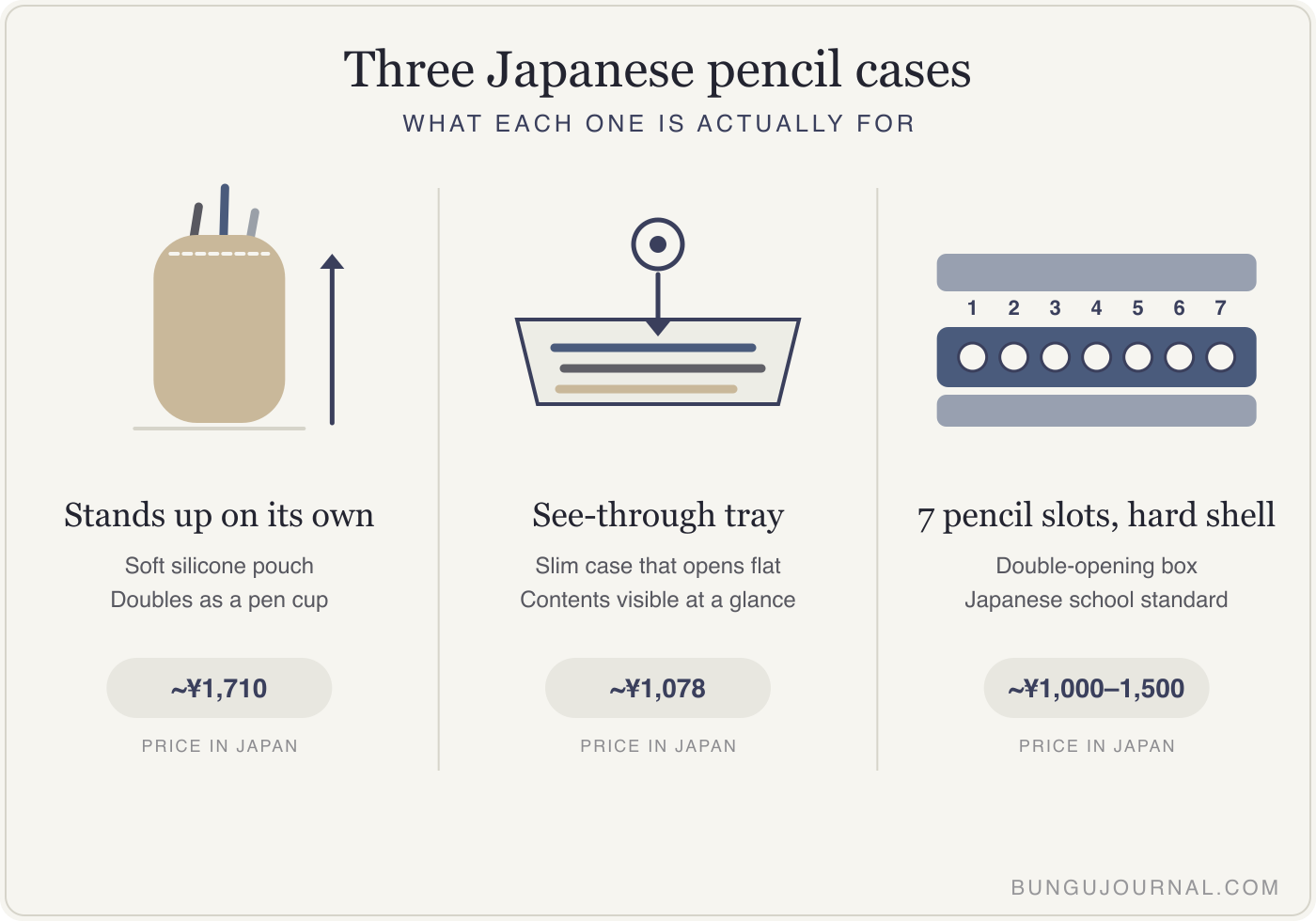
This is a soft silicone pouch with a zipper, and the trick is that the body holds its shape even when it’s open — stand it up and it works as a mini pen cup on your desk instead of flopping flat the second you unzip it. It comes in animal-shaped variants (a bear, a shiba inu, a tuxedo cat), and it runs around ¥1,710. The lid has a built-in eraser holder, which is a nice touch. The catch: silicone zippers on cases like this are the first thing to wear out if you’re rough with them, so it’s not the one I’d hand to a kid who treats a pencil case like a stress ball.
Kokuyo C2 — the slim case that opens into a tray
The C2 is a slim zippered case that unfolds into a tray once it’s open, so your pens sit in front of you instead of at the bottom of a bag-shaped pouch. It’s narrow enough to slide into almost any bag pocket, and the clear version lists at ¥1,078 including tax. The appeal is purely practical: with the clear one, you can see what’s in it without unzipping anything, which matters more than it sounds like it should when you’re digging through a bag one-handed on a train. The tradeoff is that it’s a soft case, not a box — nothing’s protected from getting crushed if something heavy lands on top of it.
The hard double-sided box — still the default at Japanese elementary schools
This is the style most Japanese kids grow up with, and it’s still everywhere. Sized to slide sideways into the side pocket of a randoseru (the stiff, boxy backpack almost every Japanese elementary schooler carries), a typical double-sided box case runs about 22cm by 9cm by 2.6cm, weighs under 200 grams, and has a built-in holder with seven round slots sized for standard 7–8mm Japanese pencils — not the pencils you’d find at a US drugstore, which run narrower. Prices for this style cluster around ¥1,000–1,500 depending on the brand and whether it’s licensed with a character. It’s genuinely tough — it’s built to survive years of being dropped and sat on in a school bag — but it’s also the bulkiest of the three, which is exactly why most adults age out of it the moment nobody’s making them carry one.
The mistake people make buying one as an adult
The instinct is to buy whatever looks the most like a “real” product — usually the hard box, because it looks sturdier on a store shelf. For a desk at home or an office, that’s backwards. The box case solves a problem adults don’t have (surviving a backpack, passing a school’s design rules) and ignores one they do have (fitting flat in a bag, looking like it belongs on a desk next to a laptop). If you’re buying for yourself and not for a six-year-old, start with the C2 or the PuniLabo, not the box. Save the nostalgia box for an actual nostalgia purchase.
One more thing worth knowing before you order: dimensions on Japanese pencil cases assume Japanese pencils and pens, which run slightly different in diameter from what’s common elsewhere. A case built around seven slots for 7–8mm pencils will still hold ordinary Western pencils fine — the round slots are forgiving — but a snug zippered sleeve made for slim Japanese gel pens can feel tight with a chunkier Western ballpoint.
The comparison table
| Lihit Lab Smart Fit PuniLabo | Kokuyo C2 | Classic double-sided box | |
|---|---|---|---|
| Material | Soft silicone | Soft (clear version available) | Hard plastic |
| Shape | Stands open on its own | Opens into a tray | Double-hinged box |
| Pencil holder | No (loose interior) | No (loose interior) | Yes, 7 slots for 7–8mm pencils |
| Price (Japan) | ~¥1,710 | ~¥1,078 (clear) | ~¥1,000–1,500 |
| Best for | Desk use, standing storage | Slim bag carry, seeing contents fast | Kids, school rules, durability |
What I wouldn’t bother with
Skip the character-licensed box cases as an adult. They’re built for a market where the appeal is the license, not the case, and a grown-up version of that same appeal just reads as a kid’s case that followed you to the office. If nostalgia is really what you want, that’s fine — just know what you’re buying it for.
I’d also skip buying the stand-up silicone style if you’re someone who eats lunch at your desk. It’s a small thing, but a case that holds its shape also holds onto crumbs and spills a little too well, and silicone doesn’t forgive a coffee ring the way a smooth plastic case wipes clean.
And a short one: none of these three fix a messy desk. A pencil case just moves the mess into a smaller container.
Buying it from outside Japan
All three are easy to find inside Japan at Loft, Tokyu Hands, or any Kokuyo/Lihit Lab display at a bigger stationery store, for close to the yen prices above. Outside Japan, the C2 and the PuniLabo both show up through import stationery retailers reasonably often; the plain double-sided box case is the hardest of the three to find abroad, mostly because it’s sold as school supply rather than a lifestyle product, so overseas retailers don’t stock it much.
If pencils are what’s actually going in the case, my Kuru Toga breakdown covers the mechanical pencil that’s probably worth pairing with whichever case you pick. For erasers, the Japanese eraser guide covers what’s actually worth putting in the case next to them. And if you’re building out a full desk setup rather than just one case, why Japanese pens write better and the Zebra Mildliner breakdown are the next two pieces worth reading.
Buy the Kokuyo C2 first if you’re not sure. It’s the cheaper of the two adult picks, and it’s the one that’s genuinely useful for an adult desk rather than useful for surviving a randoseru.
— Sen
The Desk Reset (Free)
A 10-minute checklist to set up a calm, analog-friendly desk — the Japanese office worker way. Printable, one page.
Get the checklist →