Gifts
Japanese Stationery Gifts: 7 Small Picks That Actually Get Used
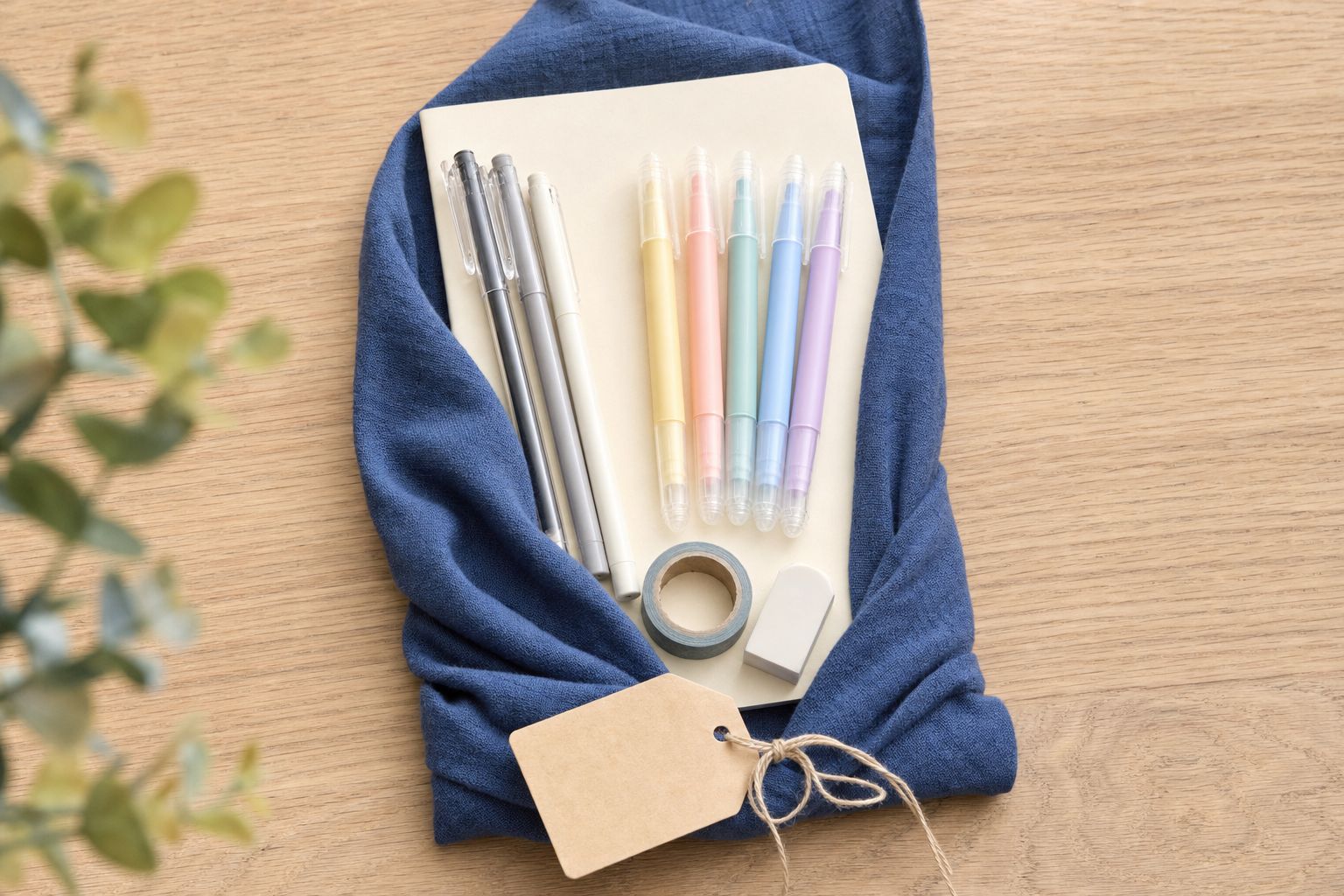
Most Japanese stationery gifts fail in the same quiet way. Nobody hates them. They just end up in a drawer.
The short answer: buy the kind of tool the person already uses, in the version people in Japan reach for every day — a better pencil for someone who writes in pencil, a muted highlighter set for someone who keeps a planner, a cheap real fountain pen for someone who’s been curious. Skip the big themed boxes and the most expensive notebook on the shelf. Below are seven small picks, matched to the kind of person they suit, with what each one costs in Japan so you know what a fair price looks like abroad.
A quick word first: bungu (文具) is simply the Japanese word for stationery. It’s the everyday word, not a fancy one.
Why so many stationery gifts end up in a drawer
I’ve done this to myself. A coworker once talked me into buying an imported premium notebook — the kind with heavy paper and a nice cover. The ruling was so loud I never wanted to write in it. I wrote four pages, put it in the back of a desk drawer, and went back to my usual Kokuyo Campus.
That’s the trap with stationery gifts. A “special” notebook or pen asks the person to change how they write, and most people don’t. The gifts that survive are the boring-looking ones that slot straight into a habit they already have.
So instead of asking “what’s the nicest Japanese stationery?”, ask one question: what does this person already write with, and on what? Every pick below answers that question for one type of person.
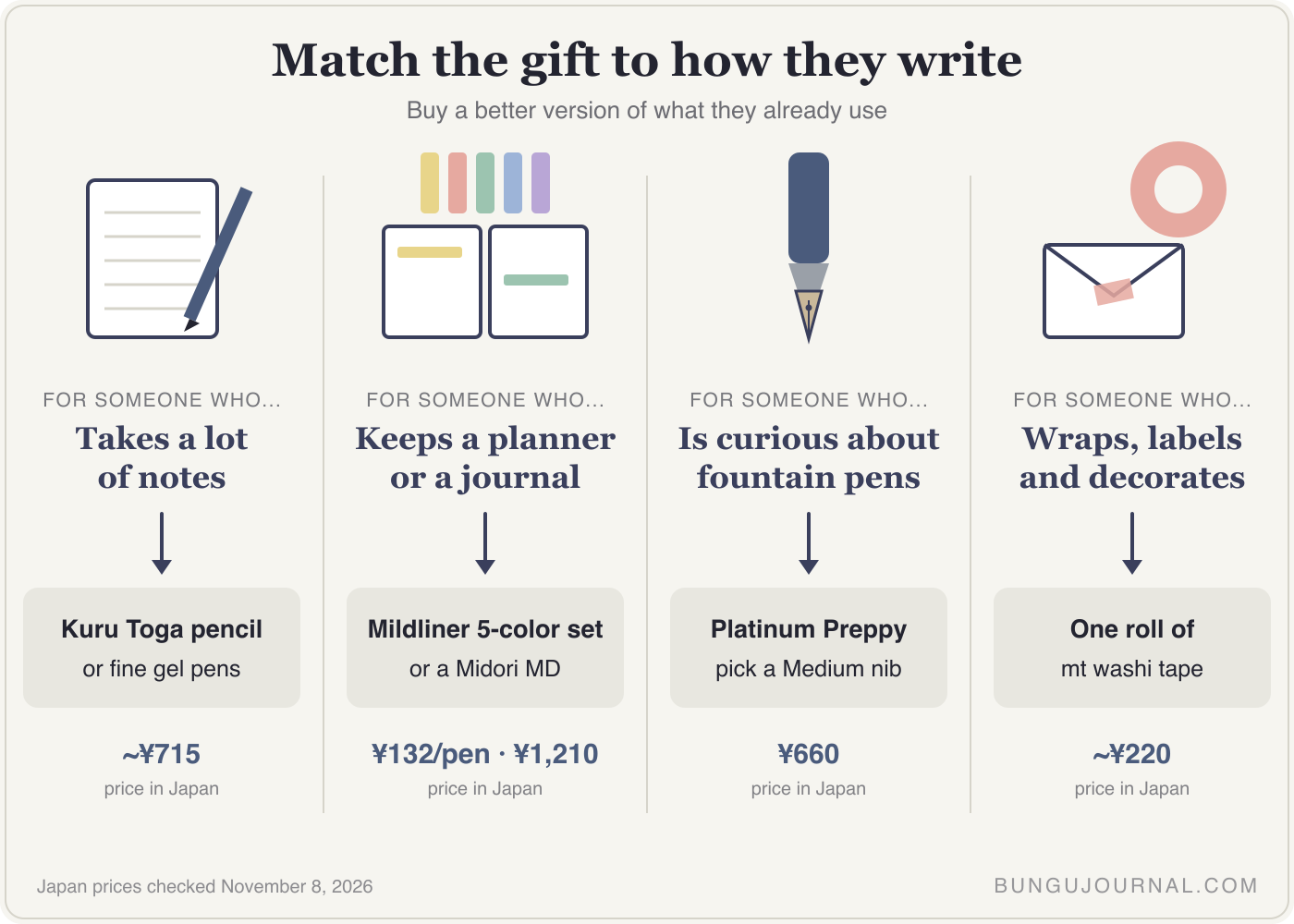
For the person who takes a lot of notes
1. Kuru Toga mechanical pencil
If they write in pencil, this is the safest gift on the list. The Kuru Toga rotates the lead a tiny bit every time the tip lifts off the paper, so the point stays sharp instead of wearing into a flat, smudgy wedge. The standard model is about ¥715 in Japan. It’s a cheap plastic pencil to look at, which is exactly why it gets used — nobody saves it for a special occasion.
The honest downside: if they mostly write long, unbroken lines (drafting, shading), the rotation doesn’t kick in much. The full Kuru Toga breakdown covers which model fits whom. Outside Japan: check the standard Kuru Toga at Stationery Pal (affiliate link; 0.5 mm, $6.97 on November 13, 2026).
2. Two or three fine gel pens
This is the stocking-stuffer pick. Fine Japanese gel pens — Zebra Sarasa, uni-ball Signo — are what you’ll find in pen cups across Japanese offices, and they’re cheap enough to give three colors instead of one. On November 13, 2026, Stationery Pal listed the Sarasa Clip 0.5 mm in black at $1.68 and the Signo UM-151 0.38 mm at $2.08 (affiliate links).
One catch: Japanese “fine” really is fine. If the person has large handwriting, 0.5 mm is the safer choice than 0.38. Why Japanese pens write better explains where that thin-line habit comes from.
For the planner and the journaler
3. A five-color Mildliner set
Mildliners are double-ended highlighters in soft, muted colors, about ¥132 per pen in Japan. They’re popular with people who keep a planner or a study notebook because the colors don’t shout off the page.
Give the five-color set, not the big 40-color case. Most people settle into a handful of colors, and the rest of a big tin just sits there. Outside Japan: check a 5-color Mildliner set at Stationery Pal (affiliate link; $7.24 on November 13, 2026). The downside, to be fair: muted means harder to spot from across a desk. The Mildliner guide goes into that.
4. A Midori MD notebook
If you want one “nice” notebook on this list, make it this one. The MD Notebook A5 lined is ¥1,210 at Midori’s Japanese list price, with a plain cream cover and paper that’s pleasant with fountain pens. It’s quiet — no loud ruling, no big logo — which is the opposite of the notebook I left in my drawer.
Not for everyone, though. If the person fills a notebook a month with meeting scribbles, an MD is too precious; a stack of Kokuyo Campus is what they’ll actually use. Midori MD vs. Kokuyo Campus lays out who each one is for, and the full notebook guide has the rest of the shelf.
For the person who’s curious about fountain pens
5. Platinum Preppy
The Preppy is a real fountain pen for ¥660 at Platinum’s Japanese list price. It has a sealed inner cap, so it doesn’t dry out quickly between uses, and it’s cheap enough that if the person finds out fountain pens aren’t for them, nobody feels bad about it. That makes it a better first gift than a handsome $40 pen they’ll be scared to ink.
Two warnings. Japanese nibs run about one size finer than Western ones, so for most people a Medium is the better pick. And on November 13, 2026, Stationery Pal only listed a Kokuyo collaboration version, not the plain Preppy, so I’m not linking it there. The fountain pen starter guide covers where to look and what to pick third.
Small extras that make the package
6. A Tombow MONO eraser
This one’s partly nostalgia. When I was in elementary school, the big game was flicking erasers across the desk to knock each other’s off the edge. Everyone carried a chunky eraser for it — and there was always one kid with a giant one, which we all agreed was cheating. Seriously, it was so much fun.
The MONO is the plain white-and-blue eraser that has sat in Japanese pencil cases for decades: a two-pack of the small size runs about ¥154 at Japanese stores. On its own it’s a strange gift. Tucked in next to a Kuru Toga, it makes the pencil feel complete. The eraser guide explains why nobody in Japan uses the pink one on the end of a pencil.
7. One roll of mt washi tape
A single 15 mm roll of mt is about ¥220 in Japan. It’s really just good masking tape in nice colors, and it’s the one item here that works for people who don’t write much at all — they’ll use it to label jars, seal envelopes, or wrap the next gift. One or two rolls is plenty. The mt guide covers the colors and widths.
What I wouldn’t buy as a gift
- Big mixed “Japanese stationery” mystery boxes. You lose the whole point — matching the tool to the person — and you pay for filler.
- The most expensive notebook on the shelf. See my drawer. Expensive paper makes people nervous to write.
- Anything chosen for the packaging alone. A pretty box with a pen nobody likes is still a pen nobody likes.
And a confession that probably helps: these days I barely use stationery myself — a ballpoint and plain paper for scribbling notes, and that’s about it. Which is exactly why I trust the “boring” picks. The things that survive on a real desk are the ones you stop noticing.
Quick recap
- Ask what they already write with, and buy a better version of that.
- Pick small and everyday over big and special.
- Use the Japan price as a sanity check for what you pay abroad.
So who’s on your list — a pencil person, a planner person, or someone who’s been eyeing fountain pens? If it’s a pencil person, start with the standard Kuru Toga at Stationery Pal (affiliate link).
That’s my bungu way.
— Sen
The Desk Reset (Free)
A 10-minute checklist to set up a calm, analog-friendly desk — built on 5S, Japan's tidy-workplace method. Printable, one page.
Get the checklist →