Erasers
Japanese Erasers, Explained: Why Nobody Here Uses the Pink Rubber on a Pencil
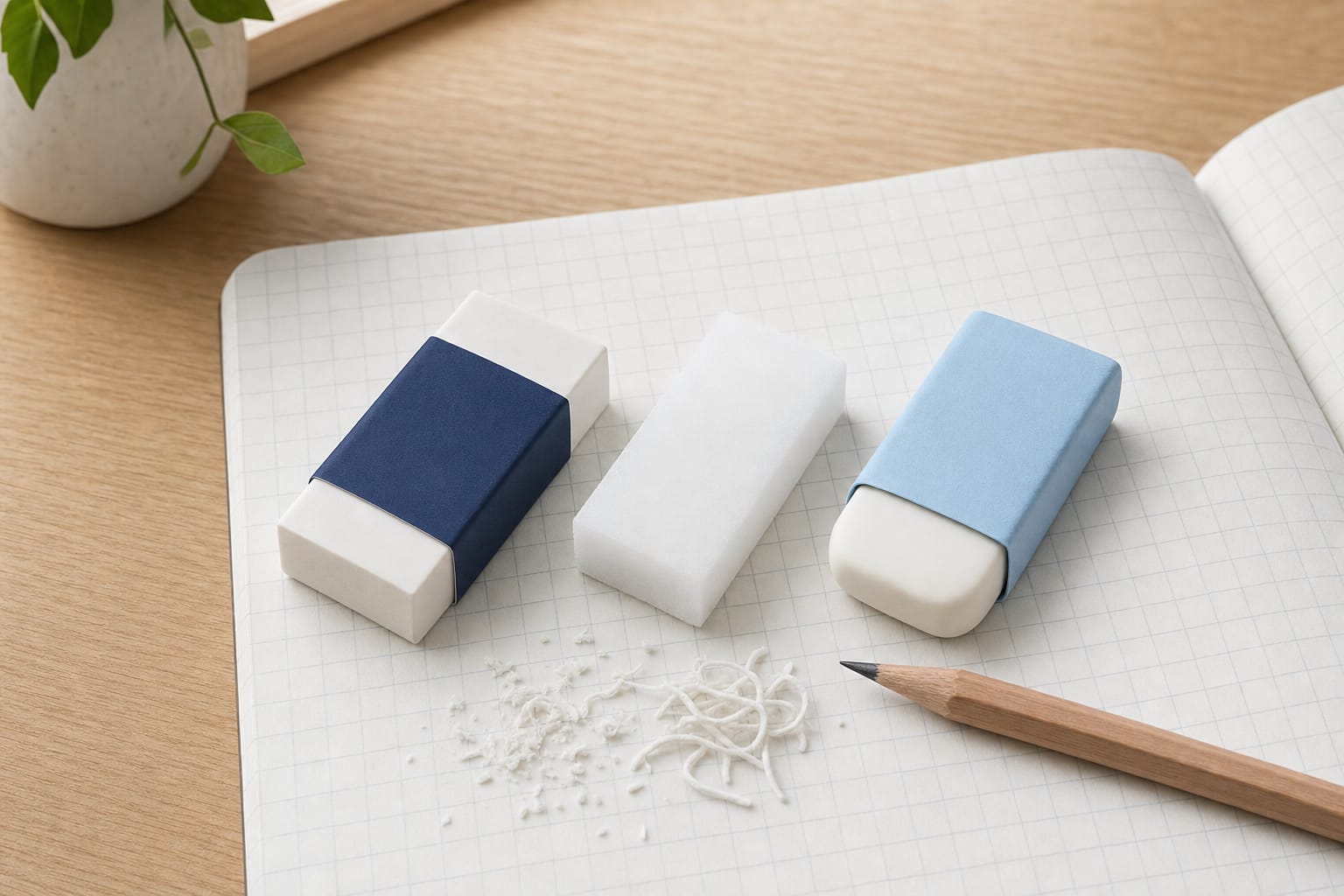
Pull the eraser off the end of an American pencil and you’ll find pink rubber, usually already cracked or shiny with age, that smears more than it lifts. Nobody in Japan expects an eraser to work that way, because the country that sells you the pencil also happens to be the one that invented the alternative.
The short answer: for everyday desk and school use, buy a Tombow MONO eraser — it’s the plain white-and-blue block that’s been in Japanese pencil cases since 1969 and it’s still what I reach for first. If you’re doing technical drawing or art and hate smudging graphite across the page, get a Sakura Foam Eraser instead; it lifts pencil lead without grinding it into the paper. And if the eraser is for a small kid’s hand, or you just want the lightest possible touch on thin paper, Plus’s Air-in is the one built around a lighter touch. All three below, plus the 1956 invention that made this whole category possible.
Why Japan doesn’t use the pink rubber
Here’s the part most import reviews skip entirely: the modern plastic eraser — the hard, usually white or gray block that dominates every stationery aisle in Japan — didn’t always exist. Erasers used to mean natural rubber, the same pink compound still glued to the end of pencils in the US, and rubber erasers have a real flaw: they degrade. Rubber oxidizes, hardens, and eventually smears oily residue across a page instead of lifting graphite cleanly off it.
A company called Seed, founded in Osaka in 1915 as a small natural-rubber workshop, spent decades making rubber erasers before deciding the material itself was the problem. In 1956, Seed became the first company in the world to put a PVC-based plastic eraser into production — softer and lighter in feel than rubber, and, crucially, one that erases by lifting graphite into itself rather than crumbling into gray dust. That single manufacturing shift is the reason a Japanese stationery aisle doesn’t have a “rubber eraser” section at all.
It just has erasers, and nearly all of them are vinyl.
That’s also why Japanese erasers come as a plain rectangular block in a paper sleeve instead of a pencil-top nub. A block eraser can be pushed straight down onto a page with even pressure across a flat edge; a pencil-top eraser can only pivot on one small rounded corner. Once the country standardized on the plastic block, the shape stuck because it actually worked better, and nobody had a reason to switch back.
The notebook lesson that applies here too
I’ve made the “imported must mean better” mistake before, and not with an eraser — with a notebook. A colleague once talked me into buying a “premium” import instead of my usual Kokuyo Campus, and the ruling was so heavy-handed I never warmed up to it. It’s been sitting four pages deep in a desk drawer for over a year.
Erasers have the same trap, just quieter. A fancier-looking eraser in a nicer wrapper doesn’t automatically erase better, and a couple of the novelty erasers sold to tourists barely erase at all — more on that below. The plain, unglamorous option has usually earned its spot on the shelf the hard way.
Three erasers, three different jobs
Tombow MONO — the one in every Japanese pencil case
Tombow, a Tokyo pencil maker founded in 1913, launched the MONO eraser in 1969 as a spin-off of the eraser that shipped with its MONO 100 drawing pencils two years earlier. The blue-black-and-white striped sleeve hasn’t meaningfully changed since. It comes in three sizes — small (PE-01A), medium (PE-04A), and large (PE-09A) — and the small two-pack runs about ¥154 in Japan, which is roughly what a can of coffee costs, for two erasers that will each outlast a school term.
What makes it the default isn’t a gimmick. It’s a dense, slightly firm PVC compound that erases pencil marks in one or two passes without much crumbling, and it holds its rectangular edges through heavy use instead of rounding into a useless pebble. The downside is exactly what you’d expect from something built for everyday abuse: it’s not especially gentle on soft, thin paper, and pressing hard enough to erase a stubborn mark can occasionally dent or fuzz cheap notebook pages.
Sakura Foam Eraser — the one that doesn’t smear
Sakura Color Products, an Osaka company founded in 1921 and best known for inventing the Cray-Pas oil pastel, makes an eraser line built around a different problem entirely: keeping graphite from smearing across a page during long drawing or drafting sessions. The Foam Eraser Double 60, a common size, runs around ¥136. Its shavings clump into small strings rather than crumbly dust, so the graphite you lift gets carried away in the string instead of staying on the eraser’s face and being dragged back across the page.
That’s the whole appeal for anyone doing pencil art, technical drafting, or repeated erasing on the same spot — sketch artists specifically favor it because a dirty eraser is often the actual cause of a “smudged” drawing, not the pencil. It’s a genuinely narrow specialty, though. For quick daily erasing of a to-do list or homework answer, it doesn’t erase meaningfully faster or cleaner than a MONO, and it costs about the same for a tool most people won’t use to its full purpose.
Plus Air-in — the light-touch option
Plus Corporation, a Tokyo company that traces back to a 1948 merger of two office-supply wholesalers, builds its Air-in line around a compound mixed with porous ceramic powder and air-filled capsule powder rather than a solid block of vinyl. The result is a noticeably softer eraser that needs less downward pressure to work, and the case itself has a curved top specifically so it resists snapping in a bag or pencil case. A standard Air-in (ER-100 series) lists for roughly ¥100–110.
That lighter touch is genuinely useful for a small child’s hand, which hasn’t developed the pressure control to erase cleanly with a firmer eraser, or for anyone erasing on paper thin enough that a hard block risks tearing it. The tradeoff: on dense graphite or a heavily pressed pencil line, the softer compound needs more passes to finish the job than a MONO does.
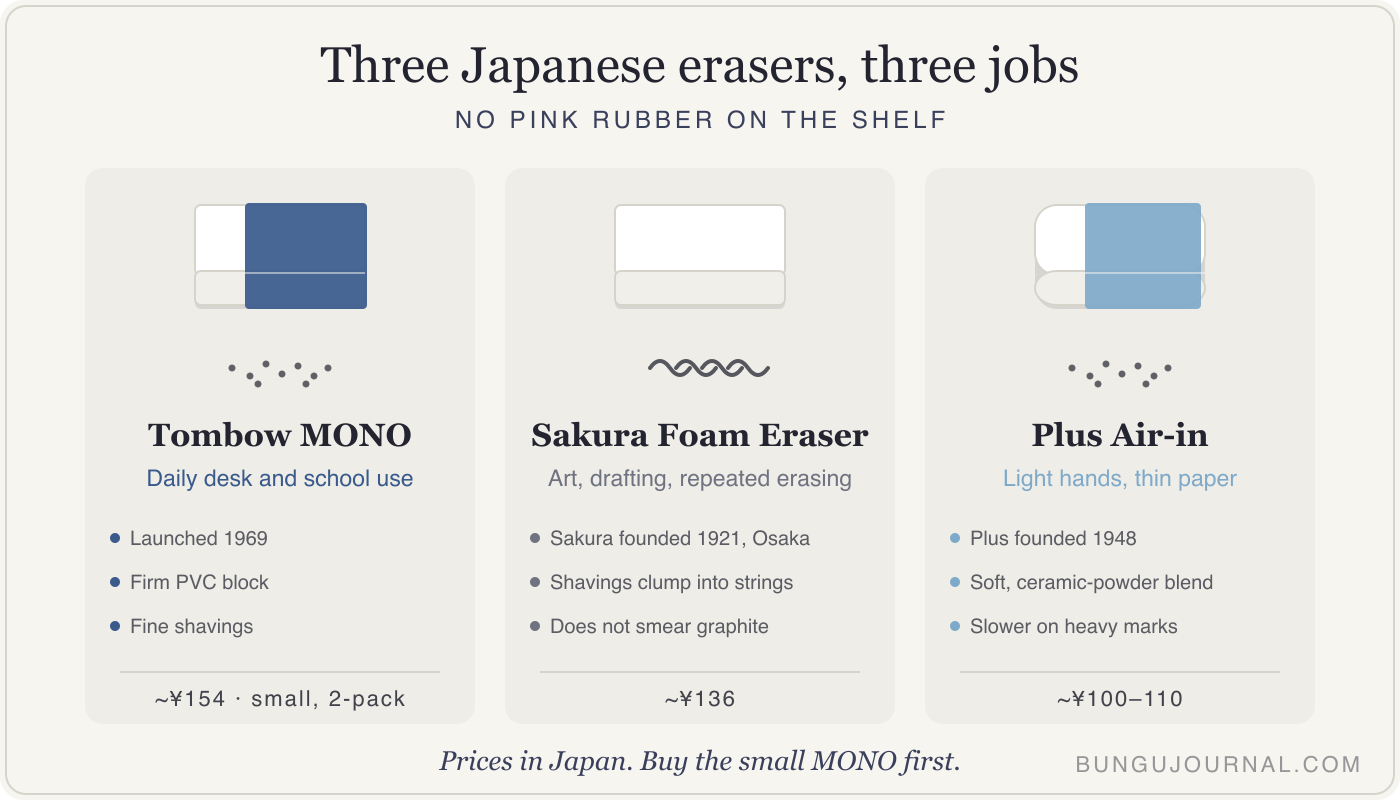
The comparison table
| Tombow MONO | Sakura Foam Eraser | Plus Air-in | |
|---|---|---|---|
| Launched | 1969 | — (Sakura founded 1921) | — (Plus founded 1948) |
| Feel | Firm PVC block | Foam-like, non-smearing | Soft, ceramic-powder blend |
| Best for | Daily desk and school use | Art, drafting, repeated erasing | Light hands, thin paper |
| Shavings | Fine | Clump into strings | Fine |
| Price (Japan) | ~¥154 (small, 2-pack) | ~¥136 | ~¥100–110 |
| Downside | Firm on delicate paper | Overkill for quick daily use | Slower on heavy pencil marks |
What I wouldn’t bother with
Skip the novelty shaped erasers — the Mt. Fuji two-layer ones and the fruit-shaped sets sold at tourist shops and airport stationery counters. They’re designed to be cute and to reveal a pattern as they wear down, not to erase efficiently, and the odd shapes make it hard to get a flat edge onto the page. Buy one as a gift. Don’t expect it to replace the eraser you actually use.
And don’t buy the largest size of anything as your first purchase. A big block eraser sounds efficient, but most desk use is small corrections rather than clearing half a page, and a smaller eraser is easier to control precisely without smudging the line next to the one you meant to fix.
Buying it from outside Japan
Inside Japan, the MONO is at almost any convenience store, and all three are on the shelf at Loft or Hands (the chain formerly called Tokyu Hands) for close to the yen prices above. Outside Japan, Tombow MONO in particular is easy to find through import stationery retailers, usually sold in multi-packs that work out a little more expensive per eraser than buying singles in Japan.
If you’re pairing this with the rest of a desk setup, the Kokuyo Campus vs. Midori MD notebook comparison covers the paper an eraser like this actually gets used on, and the same MONO name shows up again — attached to a built-in eraser cap — in my Kuru Toga mechanical pencil breakdown. If pencils lead you toward pens instead, why Japanese pens write better covers the same obsession with getting an everyday tool exactly right. And if bleed-proof, no-mess desk tools are the theme you’re chasing, the Zebra Mildliner breakdown is solving the same problem from the ink side instead of the graphite side.
A page erased with a MONO looks properly sukkiri — a clean, uncluttered kind of clean, with no gray haze left behind — and that’s a small, unglamorous thing to get right. Buy the small Tombow MONO first. At under two dollars for a pair, there’s no real reason not to.
— Sen
The Desk Reset (Free)
A 10-minute checklist to set up a calm, analog-friendly desk — the Japanese office worker way. Printable, one page.
Get the checklist →