Pen Culture
Why Japanese Pens Write Better: The 0.38mm Rabbit Hole, Explained
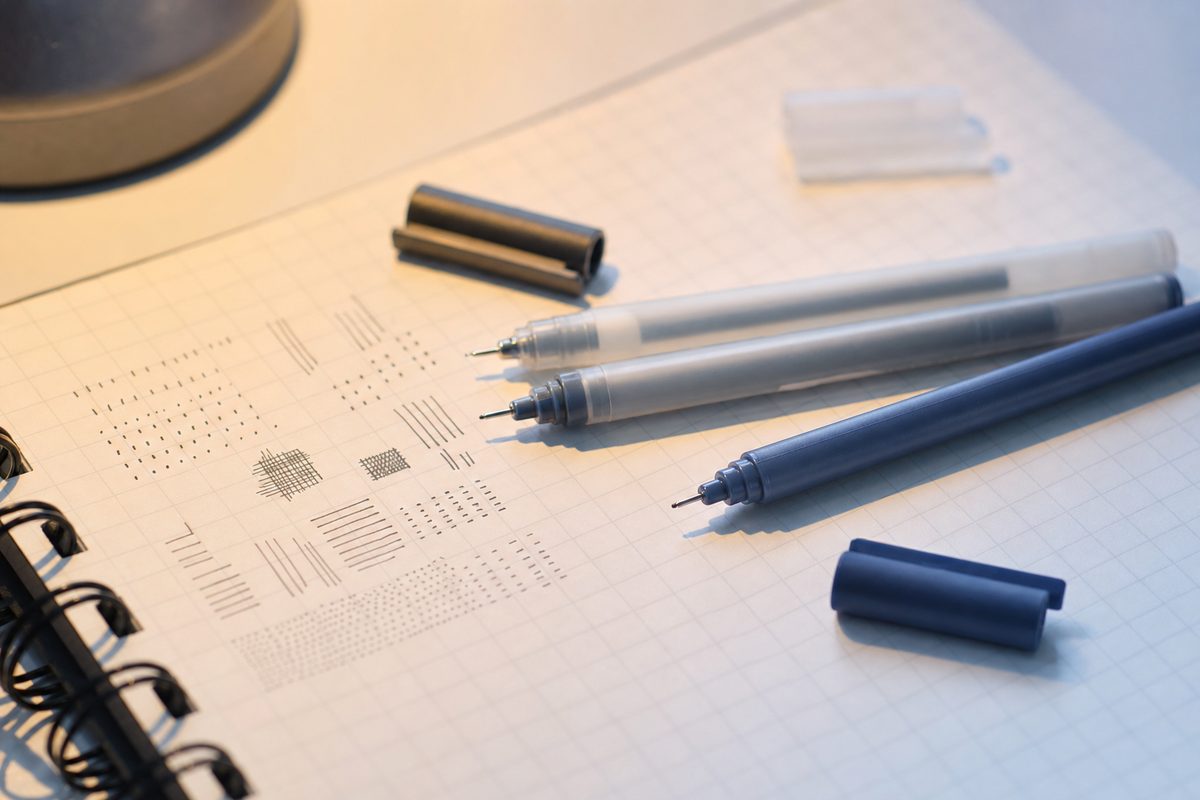
Ask any stationery obsessive to name the best everyday pens on earth and the list comes back sounding like a Tokyo train announcement: Uni-ball, Pilot, Zebra, Pentel. There are concrete engineering reasons Japanese pens took over the world’s pencil cases, and once you know them, the whole best-pens landscape makes sudden sense.
Reason one: the language demanded finer tips
Here’s the origin story in one image: try writing 憂鬱 — “melancholy,” 44 strokes across two characters (the second one alone is 29) — with a chunky 1.0mm ballpoint in a space five millimeters square. You get a black smudge.
Japanese (and Chinese) writing packs dramatically more strokes into the same cell than the Latin alphabet does. Students fill exam grids, planners have famously tiny boxes, and every stroke has to stay distinct. I went through my entire school life here filling those answer grids, and I can still hear the sound of thirty students erasing kanji at once — when ultra-fine tips arrived, they honestly felt like cheating. Western pen makers had no reason to build a reliable 0.38mm tip; nobody writing “the” needed one. Japanese makers had an entire population that did.
Making an ultra-fine tip that doesn’t scratch, skip, or clog is genuinely hard — the ball is about a third of a millimeter across, and the tolerances around it are measured in microns. That manufacturing capability, developed under domestic pressure, is the moat. When the rest of the world discovered that tiny tips also make English handwriting look precise and intentional, Japanese makers were the only ones standing there with the machines.
Reason two: the gel ink revolution happened in Japan
The other half of the story is chemistry. Oil-based ballpoint ink (the Bic default) is reliable but gluey — it needs pressure, and it writes gray-ish. Water-based rollerballs glide but bleed and smear.
Gel ink — pigment suspended in a water-based gel that liquefies under the ball and sets instantly on paper — split the difference: vivid, dark, low-pressure, fast-drying. It was commercialized by Japanese makers in the 1980s, and they have iterated on it relentlessly ever since. The modern versions barely feel related to early gel pens: today’s flagship inks combine gel vividness with ballpoint reliability, dry fast enough for left-handed writers, and hold a line so consistent it looks printed.
The practical consequence: a ¥150 Japanese gel pen out-writes prestige pens costing a hundred times more. Not “for the price.” Outright.
Reason three: the culture takes ¥150 objects seriously
The deeper reason — the one that explains why the iteration never stops — is that Japan treats everyday tools as worthy of obsession. Stationery here is a mainstream adult interest: department stores dedicate floors to it, magazines rank pens annually, and a new ink formulation gets covered like a phone launch. There’s a word for this whole territory — bungu (文具) — and no perfect English translation, which is roughly why this site exists.
When a market cares that much, a maker can justify re-engineering a pen clip, or spending years on an ink that’s 8% darker. Multiply that by four fiercely competing companies and forty years, and you get shelves where the cheap pens are the technical marvels. It’s the same cultural machinery that produces planners people organize their lives around.
So which tip size is “right”?
The honest starter map, learned from years of daily writing:
- 0.5mm — the safe default for most English handwriting. Fine but forgiving.
- 0.38mm — the sweet spot once your hand adjusts. Precise without scratching. This is the rabbit hole’s front door.
- 0.28mm and below — for tiny planners, margin notes, and people whose handwriting resembles microfilm. Wonderful, specialized.
- 0.7mm+ — signatures and whiteboard-adjacent boldness. Fine, but you’re leaving the magic on the table.
If you’re coming from Western pens, the first week at 0.38mm feels needle-like. Then your notes get smaller, neater, and oddly satisfying, and 1.0mm pens start feeling like writing with a crayon. I’m sorry in advance: this is a one-way door.
Japanese pens write better because an entire country quietly refused to accept that a cheap pen should write badly. The least you can do is borrow the result.
Next up: the five pens I’d hand a beginner, and one famous pen I think is overrated. Until then — what are you writing with right now? If the answer is “whatever was in the drawer,” I have news for you.
— Sen
The Desk Reset (Free)
A 10-minute checklist to set up a calm, analog-friendly desk — the Japanese office worker way. Printable, one page.
Get the checklist →